


Alternative financing:
Why companies should think more independently of banks
Bank mergers, changes in lending strategies and stricter requirements are transforming corporate finance for small and medium-sized enterprises. Those who rely heavily on individual banking partners may find themselves reaching their limits more quickly as a result. Alternative financing offers companies the opportunity to diversify their liquidity, take the pressure off bank credit lines and expand their financing options in a targeted manner.
Key points at a glance
- Bank consolidation is changing the financing landscape for businesses
- Long-standing banking relationships do not always offer the same level of planning certainty
- Credit decisions can become more centralised and standardised
- Alternative financing can reduce dependence on banks
- Factoring turns outstanding receivables into liquidity more quickly
- Purchasing finance can create scope on the procurement side
- A mix of financing options makes businesses more flexible and resilient
- It is crucial to plan financing strategically at an early stage
What does alternative financing mean?
Alternative financing encompasses forms of financing that businesses can use either in addition to or independently of traditional bank loans. These include, for example, factoring, purchase financing, leasing, grants, equity capital and digital financing solutions.
For many businesses, alternative financing does not mean completely replacing their main bank. Rather, it is about broadening the base of corporate financing and creating additional flexibility. Bank loans remain a key component, particularly for small and medium-sized enterprises. At the same time, however, it is becoming increasingly apparent that a single financing instrument cannot cover every situation.
Alternative financing often addresses specific aspects of the business model. Factoring turns outstanding receivables into liquidity more quickly. Purchase financing helps with the pre-financing of goods or materials. Leasing can enable investment in machinery, vehicles or technical equipment without tying up capital all at once.
Typical objectives of alternative financing are:
- Securing liquidity
- Relieving pressure on bank credit lines
- Financing growth
- Bridging payment terms
- Planning investments more flexibly
- Reducing dependence on individual financing partners
Alternative financing therefore becomes particularly relevant when companies need greater flexibility or wish to strategically supplement their existing financing.
Why is reliance on banks becoming a risk for businesses?
Dependence on banks becomes a risk when companies are heavily reliant on individual credit facilities, key contacts or lending decisions. If banking strategies, requirements or decision-making processes change, this can have a direct impact on financing.
Many small and medium-sized enterprises have been working with their main bank for years. This relationship is valuable because it builds trust and often brings with it a good understanding of the business model. At the same time, this very relationship can give rise to dependency if a large proportion of the financing relies on just a few banking partners or a single central credit line.
The situation becomes particularly critical when the broader economic conditions change. A bank may adjust its risk policy, re-evaluate collateral or centralise credit decisions to a greater extent. Mergers or organisational changes can also lead to a change in contact persons or cause processes to take longer.

This can have significant consequences for businesses:
- Credit lines are not being extended as expected
- Decisions are taking longer
- Additional collateral is being demanded
- Financing options become more limited
- It becomes more difficult to plan for investment or growth
Alternative financing can help to reduce this dependence. It provides additional options alongside traditional bank loans and makes businesses less vulnerable when individual sources of funding reach their limits.

How is the banking landscape changing in Switzerland?
Bank concentration means that fewer institutions account for larger shares of the market. For Swiss companies, this can lead to changing points of contact, more standardised processes and new requirements in corporate financing.
Switzerland is also seeing a long-term consolidation of its banking landscape. Figures on Switzerland as a financial centre for 2026, published by the State Secretariat for International Finance, show that the number of banks fell from 275 in 2014 to 246 in 2019 and 230 in 2024. The concentration is particularly visible among the major banks, with only one major banking group reported for 2024.
For companies, this development is more than just an issue for the banking sector. The Credit Suisse crisis demonstrated that banking structures and regulation can also have an impact on the real economy. In its 2026 Financial Stability Report, the Swiss National Bank points to the need for further strengthening of banking regulation and supports measures particularly in the areas of liquidity and capital.
This does not automatically mean that access to financing will become more difficult for Swiss companies. At the same time, the SNB emphasises that banks remain resilient thanks to their capital and liquidity buffers and continue to have substantial lending capacity. Nevertheless, the trend highlights the importance of not relying solely on existing banking relationships. Companies that consider alternative financing solutions at an early stage can complement their bank facilities, diversify their liquidity sources and make their overall financing structure more resilient.
Why is the traditional bank loan not always enough?
Bank loans remain a key instrument of corporate finance. In certain situations, however, they are not sufficient – for example, in the case of growth, long payment terms, short-term liquidity requirements or when additional collateral is required.
Bank loans continue to play a particularly important role in the SME sector. KfW Research from 2025 continues to identify bank loans as the most important external financing instrument for SMEs. At the same time, current data show that companies with financing needs are more frequently reporting tighter lending conditions. According to KfW, the proportion of SMEs reporting more stringent lending conditions stood at 37.8 per cent in the fourth quarter of 2025.
A traditional loan is particularly suitable for predictable investments or longer-term financing needs. However, not every liquidity requirement arises in the long term or at a steady rate. Cash flow bottlenecks often arise in day-to-day business, for example when customers pay late, materials need to be pre-financed, or an order grows faster than the available liquidity.
In such cases, a complementary solution may be appropriate. This is not to disparage bank loans. Rather, the question should be: which financing option is best suited to which need?

What alternative financing options are available to businesses?
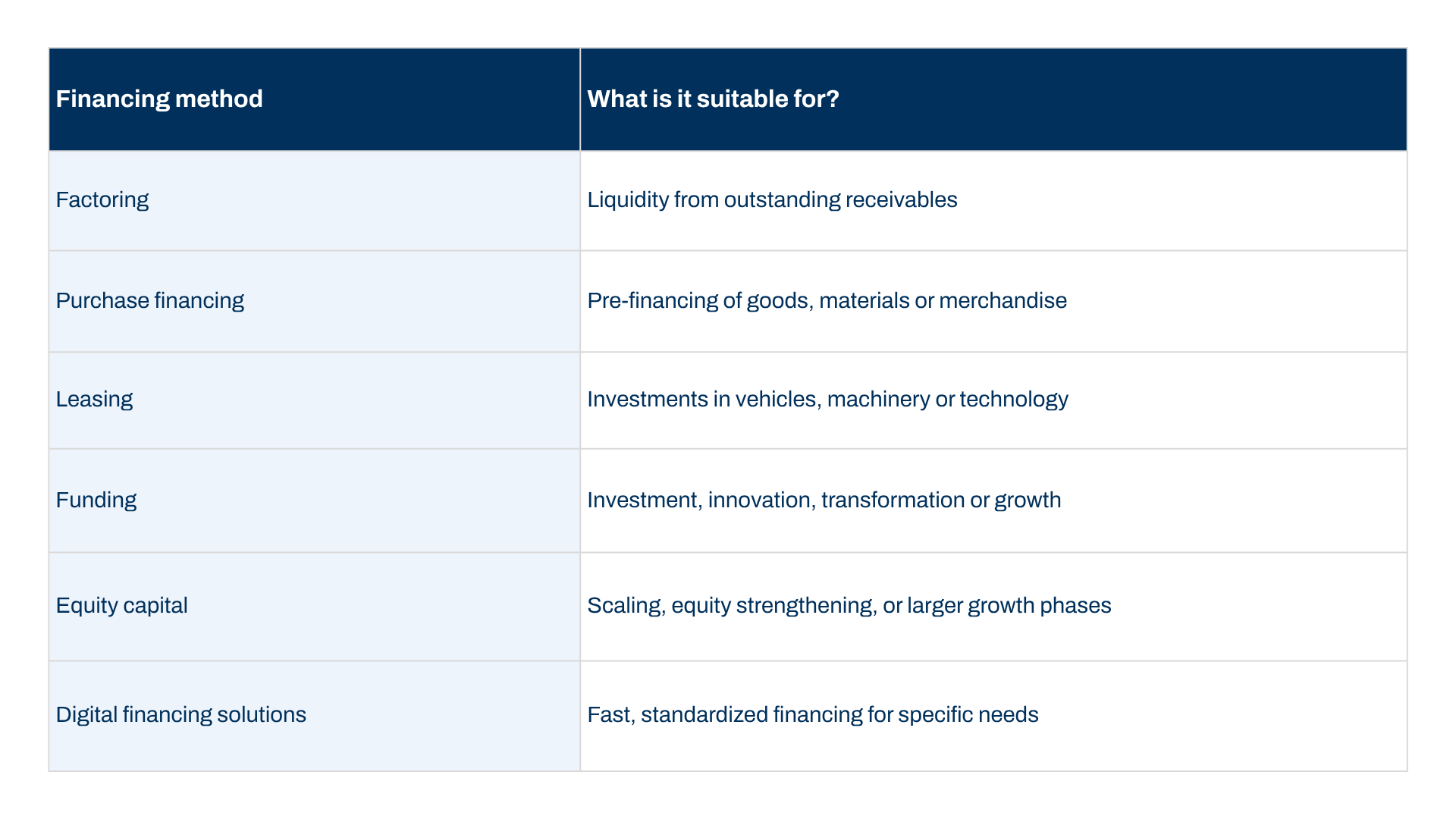
The most important alternative financing options for businesses include factoring, purchase financing, leasing, grants, equity capital and digital financing solutions. Which option is suitable depends on the business model and the specific financing requirements.
Alternative finance is not a single product, but an umbrella term for various solutions. The key factor is what the liquidity is needed for. Is it for outstanding receivables? For purchasing goods or materials? For investments? Or for growth capital?
An overview
It is important for businesses not to focus solely on the cost of financing. Speed, flexibility, predictability and the impact on existing credit facilities are equally important.
A good alternative financing solution fits in with the company’s structure. It not only resolves a short-term cash flow bottleneck, but also usefully complements the existing financing strategy.
Is factoring right for your business?
Take the 2-minute check now – it’s free, simple and without obligation.
How does factoring help with financing that is independent of banks?
Factoring can help businesses convert outstanding receivables into cash more quickly. This means that financing is more closely linked to turnover and less dependent on traditional bank credit facilities.
With factoring, a company sells outstanding receivables from the supply of goods or services to a factoring provider. The main advantage lies in the timing: rather than waiting for payment from the customer, a large proportion of the invoice amount becomes available sooner. This can be particularly helpful when payment terms are long or when growth ties up additional liquidity. This is because, particularly in B2B business, receivables often arise that are only paid after 30, 60 or more days. During this time, the company must continue to bear its own costs.
Factoring can help, amongst other things, when:
- outstanding receivables tie up capital
- bank credit lines need to be preserved
- growth needs to be pre-financed
- incoming payments need to be made more predictable
- the burden on accounts receivable management needs to be eased
- the risk of non-payment needs to be reduced, depending on the model
Factoring is therefore not a traditional form of corporate financing without a bank in the sense of a loan, but rather a financing component closely linked to turnover.
This is precisely what makes it attractive to many companies: the financing is based on existing receivables and often grows in line with turnover.
Case Study
SystemKosmetik finances sustainable growth through factoring
SystemKosmetik GmbH demonstrates how alternative financing can have a tangible impact on day-to-day business operations. The cosmetics manufacturer uses A.B.S. Factoring to convert outstanding receivables into cash more quickly and to finance production, working capital and sustainable growth in a more predictable manner.
“With factoring, we always have the necessary liquidity and working capital to finance our production. Furthermore, we also use factoring to minimise risk, as our customer base is broadly diversified – ranging from one-man businesses to large discount retailers.”
Stefan Bawidamann
Executive Finance Manager, SystemKosmetik GmbH

When does purchase financing make sense?
Purchasing finance is useful when companies need to pre-finance goods, materials or merchandise. If the available credit facility is insufficient, factoring can provide additional support to make liquidity available more quickly on the receivables side.
Many companies have financing needs even before a sale is made. Goods must be purchased, materials ordered or stock built up before revenue is realised. This is precisely where purchase financing comes in: it provides support on the purchasing side and creates the flexibility needed to fulfil orders in the first place.
In practice, however, an existing credit facility may prove insufficient. This is particularly true for larger orders, seasonal peaks or periods of strong growth. If customers also have long payment terms, this creates pressure on both sides of the business model: in procurement and in the collection of payments.
In such cases, a mix of financing options can be useful.
What are the benefits of a mix of financing options?
A mix of financing options spreads funding requirements across several components. This gives businesses greater flexibility when credit lines are limited, credit decisions take longer or additional liquidity is required.
A stable financing mix does not mean using as many financing instruments as possible at the same time. The key is that the individual components are suited to the company’s situation. The traditional bank loan can continue to play an important role. Alternative financing can complement this where bank credit lines are not ideally suited or are insufficient.
This diversity becomes particularly important in an environment characterised by bank concentration, changing credit processes and higher financing requirements. Companies that rely on just one source of financing have fewer alternatives if conditions change.
A mix of financing options can be particularly useful if:
- Bank credit lines are already being utilised to a large extent
- Payment terms tie up liquidity
- Purchasing volumes are rising
- Growth needs to be pre-financed
- Investments are due to be made alongside day-to-day business
- Credit decisions require more time
- Risks are to be spread across several financing partners
The main advantage lies in the freedom to act. Companies can manage their financing needs in a more nuanced way and do not have to resolve every situation through the same channel.

How can companies diversify their sources of funding?
Companies should review their financing arrangements regularly and not wait until existing credit lines are running low before taking action. It is crucial to consider liquidity requirements, cash flows and suitable financing instruments together at an early stage.
The first step is to carry out an honest assessment. Which sources of funding are currently being used? To what extent is the company dependent on individual banks? Which credit lines are available, which have already been exhausted, and what funding requirements arise regularly in day-to-day operations?
Building on this, companies should align their financing structure with their business model. A retail business with high cost of goods sold has different requirements to a service provider with long payment terms. A growing company needs different financial flexibility to a company with a stable but capital-intensive order book.
Specific areas to focus on are:
- analyse existing credit facilities and collateral
- assess dependence on individual financing partners
- Assess payment terms and receivables
- Consider the purchasing and sales sides separately
- Identify recurring liquidity gaps
- Examine alternative financing options at an early stage
- Regularly adapt the financing mix to growth and the market environment
Conclusion
Financing without a bank – alternative financing makes it possible
Alternative financing does not, as a rule, replace traditional bank loans. It complements them in situations where businesses require greater flexibility, faster access to liquidity or additional scope for financing.
Changes in the banking landscape highlight the growing importance of a more diversified approach to corporate finance. Mergers, bank consolidation and changes to lending processes do not automatically mean a financing problem. However, they do make it clear that companies should be aware of their dependencies and actively manage them.
Bank loans remain an important component of financing. However, depending on the business model, it may make sense to incorporate other elements. Factoring can make liquidity from outstanding receivables available more quickly. Purchase financing can support procurement. Leasing, grants or equity capital can cover other needs.
Which financing option is right for your business?
Whether it’s factoring, purchase financing or a broader mix of financing options: the most suitable solution always depends on your business model, cash flows and specific financing requirements. Particularly when bank credit lines are reaching their limits or growth is tying up additional liquidity, it is worth taking a close look at your existing financing structure.
Talk to our experts. Together, we’ll examine how your business is currently financed and where there might be scope for further flexibility.


Author of the article
Marc Meier is Managing Director of A.B.S. Factoring AG Switzerland and President of the Swiss Factoring Association (SFAV). For more than ten years, he has supported Swiss SMEs in financing their growth. He focuses on factoring as a modern source of external financing to strengthen their liquidity sustainably.

FAQ: Frequently asked questions about factoring and alternative financing
Factoring involves a company selling its outstanding receivables from the supply of goods or services to a factoring provider. This enables it to receive a large proportion of the invoice amount more quickly, rather than having to wait for the customer’s regular payment. Factoring can therefore help make cash flow more predictable. Recommended reading: Our blog post “What is factoring?”
One potential disadvantage of factoring is the cost associated with financing, risk assumption and services. Furthermore, factoring is not suitable for every business model, every receivable or every customer structure. It is therefore always important to assess whether factoring is a good fit for the company, its debtors and its payment terms.
Factoring is particularly beneficial for businesses that regularly issue B2B invoices and need to bridge payment terms. It can be particularly useful when growth needs to be pre-financed, customers have long payment terms, or outstanding receivables tie up a lot of capital. The prerequisite is usually that the services have been provided and the receivables are undisputed.
Among the common types of factoring include full-service factoring, in-house factoring, true factoring and non-true factoring. With full-service factoring, the provider takes on parts of accounts receivable management in addition to financing. With in-house factoring, accounts receivable management remains largely with the company. True factoring usually also includes protection against bad debts.
Yes, factoring is an established and reputable form of business financing, provided it is arranged through a professional provider and structured transparently. Clear contractual terms, transparent fees and a thorough assessment of the receivables are essential. For many small and medium-sized enterprises, factoring is an integral part of their financing mix.
Factoring is used by companies across many sectors, particularly in B2B business. These include, for example, manufacturing companies, wholesalers, logistics firms, recruitment agencies, mechanical engineering firms, the food industry and consumer goods manufacturers. The decisive factor is not so much the sector itself, but rather whether invoices are regularly issued to business customers. Factoring is not suitable for selling individual receivables.
Alternative financing encompasses forms of financing that businesses can use either in addition to or independently of traditional bank loans. These include, for example, factoring, purchase financing, leasing, grants, equity capital and digital financing solutions. The aim is often to diversify liquidity and reduce dependence on individual banks.
Non-bank financing means that companies do not obtain liquidity exclusively through traditional bank loans or overdraft facilities. Instead, alternative financing options are used, such as factoring or purchase financing. This enables companies to reduce the strain on their bank credit lines and organise their financing more flexibly.
A mix of financing options makes sense because different financing instruments meet different needs. Bank loans may be suitable for investments, factoring for outstanding receivables, and purchase financing for goods or materials. By combining several components, companies can reduce their dependencies and gain greater flexibility.
More posts


